Joseph Joseph
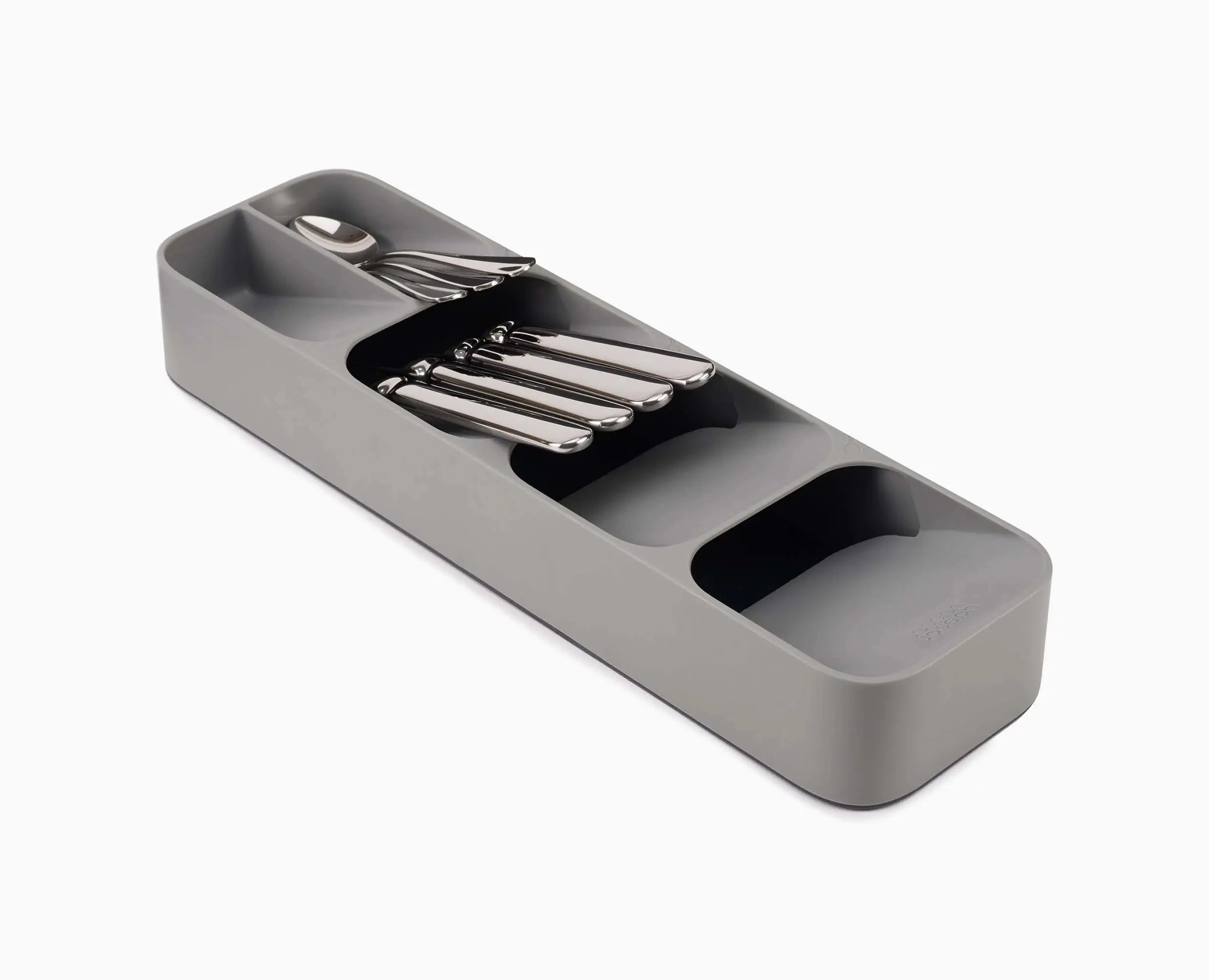
Joseph Joseph DrawerStore Cutlery Organizer
Expandable in-drawer cutlery tray. Compact footprint, angled compartments hold more. No install.
Buy on Amazon →Affiliate link — same price for you, supports Switcheroom.
Pros & Cons
What we like
- Compact design
- expandable
- clever angled slots
Watch out for
- Plastic construction
- only for standard drawers
Renter-Safe Verified
This product can be used, installed, or placed without drilling, nailing, or permanently modifying your rental. When you move out, it comes with you — and your deposit stays intact.
A narrow apartment drawer can hold the right amount of flatware and still feel unusable when a conventional tray consumes its whole width. The expanding DrawerStore tackles that geometry with overlapping cutlery compartments plus deeper sections for utensils and gadgets. The editorial verdict is strong for a renter who has measured the drawer and needs one adaptable insert, not a permanent cabinet modification. Skip it if you prefer every utensil visible at a glance or your drawer cannot accommodate the organizer's height and expansion range.
Who It Is For—and Who Should Skip It
It is for small kitchens where forks, spoons, knives, and a modest set of cooking tools must share one drawer. The expanding format makes more sense than a fixed tray when drawer widths vary between rentals. It is also useful for someone who expects to move and wants storage that lifts out in one piece. Skip it for oversized serving tools, very shallow drawers, or households that dislike stacked and overlapping compartments. A modular set of open bins is easier to scan and clean one section at a time.
What Product Details and Buyer Feedback Reveal
Official facts: Joseph Joseph's product family includes an expanding DrawerStore organizer with five overlapping cutlery compartments and two deep-sided compartments for utensils or gadgets. Current versions are offered in plastic and bamboo formats, so buyers must confirm the material and exact variant at checkout rather than assuming every DrawerStore listing is identical. The overlapping layout is intended to reduce the horizontal width occupied by cutlery, while expansion uses available drawer space for larger tools.
Buyer and review pattern: Retailer descriptions repeatedly praise the space-saving layout, but the same geometry creates the main compromise: stacked handles and directional icons require a short learning period, and pieces are less immediately visible than in a flat tray. Independent coverage of the compact DrawerStore version also focuses on how little drawer width it uses. That supports the design idea, but it should not be treated as evidence that every expanding variant fits every drawer.
Renter and Apartment Fit
| Question | Fit | Practical answer |
|---|---|---|
| Does it alter cabinets? | No | It rests inside the drawer with no adhesive or fasteners. |
| Can it move to another rental? | Yes | Lift it out, clean it, and remeasure the next drawer. |
| Does it suit any drawer? | No | Width, depth, and especially internal height must be checked. |
| Will it hold large tools? | Limited | The deeper side areas suit compatible gadgets, not every bulky utensil. |
There is essentially no deposit risk when it is used normally because nothing is attached. The real renter risk is buying for the apartment's nominal cabinet width instead of measuring the clear internal space. Hinges, drawer slides, curved corners, and a low frame can all reduce usable dimensions.
Setup Reality and Common Failure Modes
No tools are needed. Empty and clean the drawer, measure its usable width, depth, and height, place the organizer inside, expand it only as far as the current model allows, and load cutlery by type. Common failure modes include failing to account for tall stacked handles, overfilling a compartment until pieces jam, placing long utensils where they catch the drawer frame, and confusing the compact fixed-width DrawerStore with the expanding model before purchase.
The honest trade-off is visibility for density. Overlapping compartments can recover useful drawer width, but an ordinary flat tray makes every piece easier to identify and may be simpler for children or guests. Choose DrawerStore when space is the binding constraint. Choose modular open bins when the drawer is generous or when you need a layout customized around unusually shaped utensils.
Last checked: 2026-07-27. Sources: Joseph Joseph organizer page, Everything Kitchens listing, and The Spruce compact-version review.Best For
- Rental galley kitchen with one narrow flatware drawer
- Studio apartment cook combining cutlery and small utensils
- Shared apartment kitchen needing labeled flatware zones
- Frequent mover wanting removable cabinet organization
Setup & Install
No tools, adhesive, or permanent installation are required. Measure the drawer's clear internal width, depth, and height before purchase, then place and expand the correct model within its stated range. Removal has no expected cabinet damage; lift it out for cleaning or moving rather than forcing it against drawer hardware.
FAQ
Does the Joseph Joseph DrawerStore fit every kitchen drawer?
No. DrawerStore comes in multiple versions, and the expanding model still requires adequate internal width, depth, and height. Measure clear space around slides, corners, and the drawer frame before ordering.
Is DrawerStore safe for a rental apartment?
Yes. It sits loose inside the drawer and requires no screws or adhesive, so it can be removed and carried to another home without altering the cabinet.
What is the trade-off of overlapping cutlery compartments?
They save horizontal space, but flatware is less visible than it is in a traditional flat tray. Overfilling can also make pieces harder to retrieve or cause tall handles to catch the drawer.
Is the expanding DrawerStore the same as the compact model?
No. Joseph Joseph sells several DrawerStore layouts, including compact fixed-width and expanding organizers. Match the listing photos, model name, material, and published dimensions to the version you intend to buy.